Questions My Own Data Couldn’t Answer
Each app started with a question my own data couldn't answer.
Questions My Own Data Couldn’t Answer · Each app started with a question my own data couldn't answer
Why I started
By day, I design trading experiences, thinking about markets, AI, and how the speed of light can make them better. In my free time, I build apps for myself.
It started with a simple frustration: I felt the data being sent my way could be better. So I decided to build apps around my own data. With Claude Code, the iPhone Duo, and everything in between, it's been quite a year.
Each one started with a question my own data couldn't answer.
What it took
Most of this happened early in the morning before a ride on Zwift, or after dinner. Here's how they fit together:
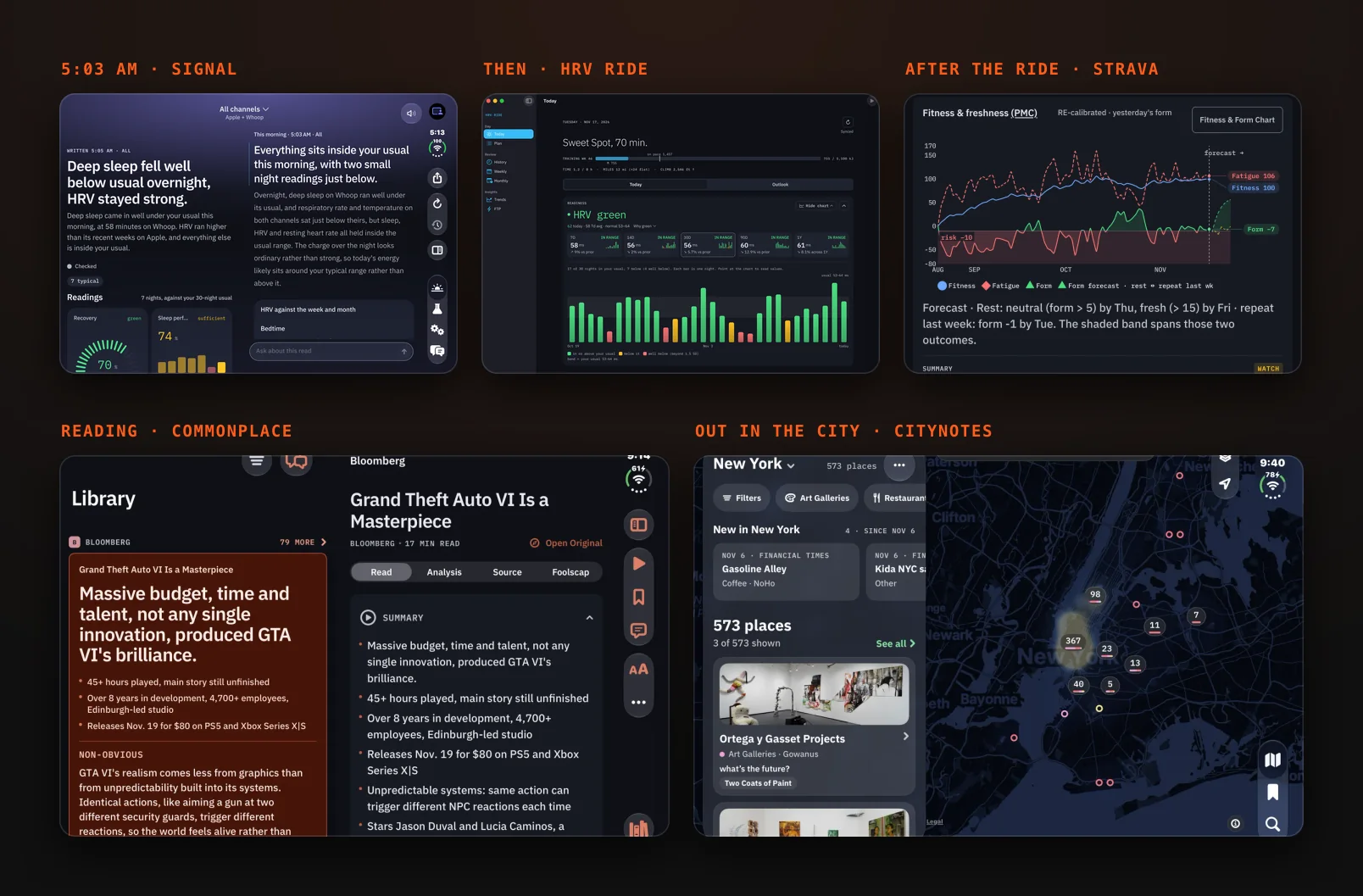
5:03 AM · Signal
“What would a doctor notice that a dashboard doesn’t?”
Before I'm up, Signal has already read the night. Deep sleep came in well under my usual, HRV stayed strong, and it says so in plain English while I make coffee.
Then · HRV Ride
“What should I ride today, given how I slept?”
HRV green, so HRV Ride makes it a Sweet Spot day: 70 minutes, with the blocks adjusted from how my body handled the same ride last week. One click and it's in Zwift.
After the ride · Strava Dashboard
“Did I ride what was planned?”
The Strava Dashboard answers that before I've showered. Power held at target, but heart rate drifted up, and the week is getting heavy.
Reading · CommonPlace
“How can I learn from what I’m reading quickly and keep it as a reference for later?”
When I save an article, it becomes a card: the main takeaway, a couple of glanceable bullets, and a non-obvious blurb that puts it in context. My highlights land in Margins, and the places an article mentions go straight to CityNotes.
Out in the city · CityNotes
“What’s around me that I might want to check out?”
A list could tell me what was showing, but not what was next to what, so I put it on a map. I open it in a neighborhood to learn things I wouldn't have known otherwise.
I started with macOS and the standard iPhone. Then I had to learn what changes when you design for the Duo's two screens. In CityNotes, the Duo turns out to be an ideal size for giving the list and the map the right relationship. Open, it's essentially a 2:1 layout: one column for the listing and two columns for the map. Closed, the ratio flips vertically, with the map on top and the list below. Signal and CommonPlace use the two screens differently: the content stays on the left, and when I want to interact with it, I pull up a chat on the right. What I'm interested in stays visible while I dig deeper. That flow wasn't really possible on a phone before the Duo.
Along the way, I learned how many ways there are to work with AI and to learn from it. I also learned about whether it's truthful, how much to trust it, and how to adjust based on experience. With Signal, I learn about AI using data points I'm already familiar with, so I can tell when a reading holds up. Where Apple and Whoop differ significantly, Signal shows that too. In CommonPlace, I used AI to take summaries beyond the usual three-bullet list. The analysis shows me how an article is structured and whether its points make a compelling argument. My most ambitious project was an agentic system for health: when I open Signal, an agent has already collected my Apple HealthKit and Whoop data and analyzed it to explain what happened.
Where it landed
With Thanksgiving a week away and Anthropic's IPO, this felt like the right moment to step back and look at what I've made. All of it is still a work in progress. Now I'm making a few more tweaks to the next set of apps I'm actively testing, which I should be posting about soon…